The usual answer is more practice, or a tutor going over the same explanation again.
We start somewhere else: we rebuild the material around your child.
How we personalise a kit
The same syllabus objectives, two different children
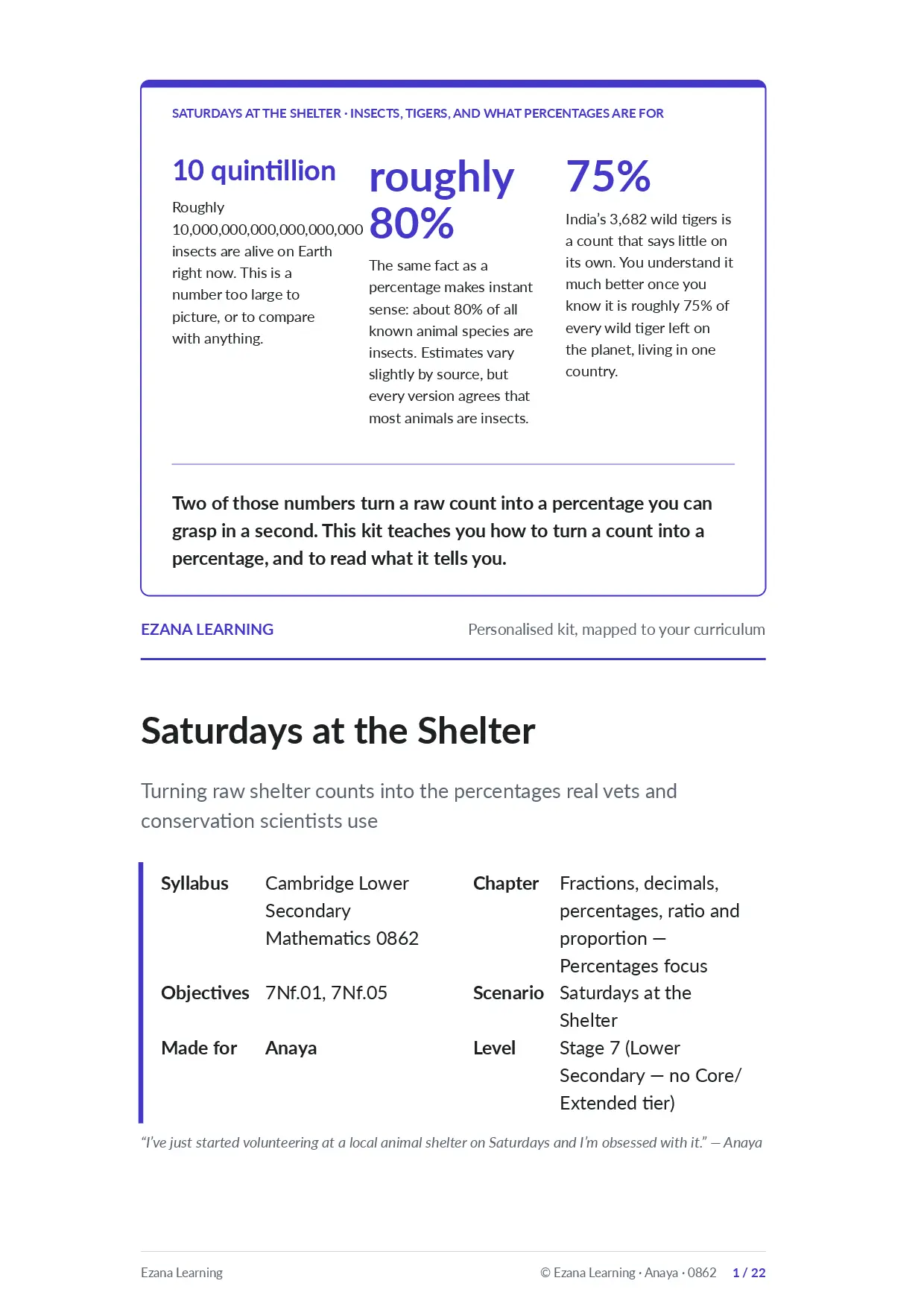
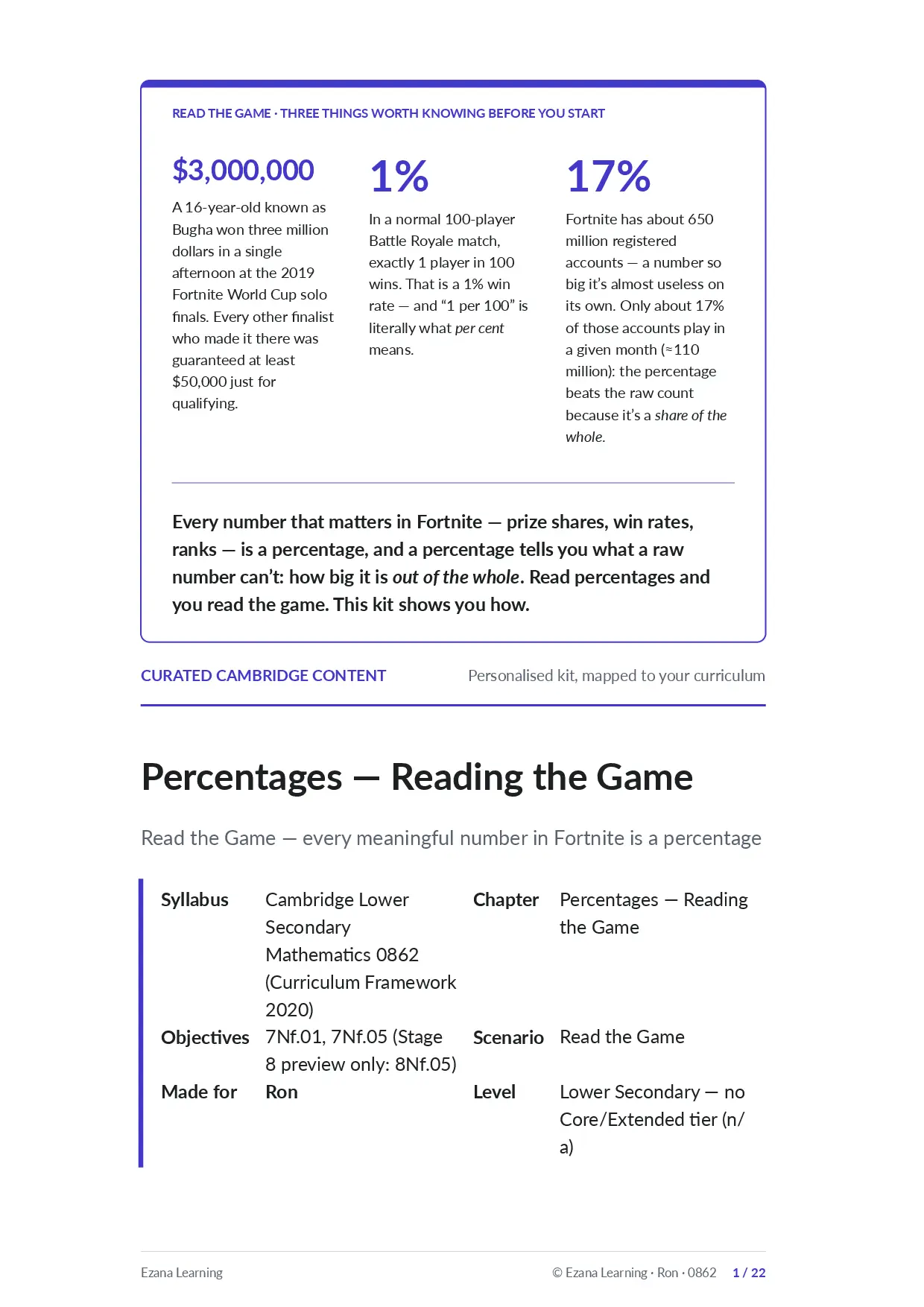
Below are the first pages of two finished Stage 7 kits. Both teach the same two
Cambridge Mathematics objectives — reading and calculating percentages (0862, 7Nf.01
and 7Nf.05). Ron's questionnaire said he loves Fortnite, gets bored quickly, and wants
to be dared. Anaya's said she volunteers at an animal shelter on Saturdays, wants
worked examples she can follow step by step, and panics under time pressure. Nothing
else about the two orders differed.
Ron, 23 pages. His kit opens on Fortnite bot ratios and
V-Bucks pricing and keeps the scaffolding minimal — showing one worked example
before moving to the practice questions.
Anaya, 22 pages. Her kit is built around shelter and wildlife
counts, shows every method fully worked before she tries it, and tells her
exactly where to check each answer.
Who the kits are for
The situations these kits are built for
The kits are built to do one job, and it comes up in several different situations. In
every one below, a child has to learn something new without a teacher standing next to
them — so the kit has to do the teaching, not just set the questions.
Tutored weekly
Your tutor has one hour a week. This is the other six days.
A tutor explains the topic in the session, and then the week has to be filled with
something. A kit covers the same topic in your child's own textbook, teaches it
from the start, and marks its own practice — so the next session begins further on
instead of going over the same ground. Tutors can order a kit per student.
Travelling in term time
Away for weeks, and the class keeps moving
Work sent home for a trip is usually a list of exercises with no teaching in it,
which assumes someone is there to explain the new part. A kit teaches the topic
from the beginning. It is a printable PDF, so it works on a train or in a house
with no internet.
In hospital or recovering
The lesson happened without them
Lessons missed through illness are hard to catch up, because the teaching happened
while your child was elsewhere and the class has moved on. A kit teaches the topic
from the beginning, and it can be done in short stretches — a page or two on the
days that allow it, rather than a lesson that has to be sat through in one go.
New school, new curriculum
Topics nobody taught them
A child who moves country, school system or exam board arrives partway through a
syllabus the class has already worked through. These gaps are not forgotten topics
— they were never taught, so nothing at school will flag them. Each kit names the
syllabus objectives it covers and follows the textbook the new class is using, so
you can order kits for the objectives your child missed and leave the rest alone.
Homeschooled
Teaching material, not just practice material
Homeschooling parents, including those whose children sit as private candidates,
need something that teaches the topic and maps to the syllabus the child will
actually be examined on. Each kit names the syllabus objectives it covers and comes
with a full mark scheme that gives model answers, so you can run the lesson and
mark it without being a specialist in the subject.
One topic went wrong
On track all term, except for this
A child can follow the whole year and still lose one topic — and the class will not
come back to it. A topic kit covers that single topic from the beginning, at your
child's level, so the gap closes without redoing the parts that were fine. This is
the size most families order first.
Preparing for an exam or a retake
The short version of a lesson your child needs in full
A revision guide condenses a topic for a student who already learned it once. If
your child never understood the topic, condensing it makes the topic harder rather
than easier, because there is less explanation on the page, not more. A kit teaches
the topic in full, then ends with exam-style questions carrying marks, which your
child uploads and we grade with written feedback.
Ahead of the class
Finished the chapter while the class is still on it
A child who works faster than the class is usually handed more questions of the
same kind. Every kit ends with a stretch section, and its extension task goes past
what the syllabus asks — in the trigonometry sample it sends the student to find out
why competitive javelin throws leave the hand at 35–42° when the formula says the
best angle is 45°. You choose the level in the questionnaire, so a kit can run ahead
of the class instead of alongside it.
Built to be understood
Claims you can verify yourself in the samples
We don't ask you to take any of this on trust — every claim below is visible in the
sample kits, page by page.
Teach first, then test
Every method is shown before it's asked
Each section opens with a worked example — the full solution, step by step — and
only then asks your child to try the same steps on a new problem, with the
scaffolding fading as they go.
Why, not just how
Understanding survives a forgotten step
Worked examples end with a short "Think: why?" — why divide before multiplying,
why 0.75 and not 75. A child who knows why a method works can rebuild a forgotten
step in a test; a child who memorised the steps cannot.
Works alone
Your child can check every answer themselves
Quick checks carry their answer printed upside-down on the same page, and the full
answers at the back show the working, not just the result. They can check and fix
their own work with no adult needed at the table.
Actual data, not themed
The numbers are from published sources
Ron's kit calculates with current Fortnite V-Bucks pricing and live bot-lobby
data, with sources named on the page. Using actual data respects the reader — children notice
the difference between their world and a theme painted on.
Human Feedback
We grade the exam-style questions
When your child finishes the kit, they upload their exam-style answers to our portal. We grade them and send personalized, constructive feedback straight to you, so you know exactly how they are tracking.
Seventeen centuries ago, King Ezana of Aksum had his inscriptions carved in three
scripts, so that every reader could understand them in their own. We build study kits
on the same conviction: every child can understand when the explanation is written
for them. So we write the curriculum again, for one child at a time.